Sarrazin Award Lectureship
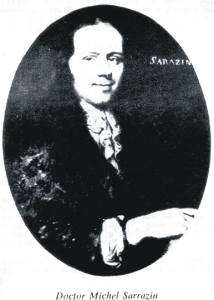
1659-1734 Doctor Michel Sarrazin "The First Canadian Physiologist"
The Sarrazin lectureship was initiated in 1976, by the Society for a “Distinguished Speaker” to give a 1 hour lecture to the Society at its meeting and that the Lectureship would be called the “Sarrazin Lecture” in recognition of “the First Canadian Physiologist”.
Although nominations were initially solicited from the membership and the Lecturer selected by the Executive, it was subsequently felt appropriate for the outgoing President of the Society to be charged with making the selection of the speaker for the subsequent Annual Meeting.
The first Sarrazin Lecturer was Dr. Harold Copp, who presented his lecture at the Winter Meeting of the Society in 1977.
2012 Sarrazin Lecturer
Duncan Stewart, MD, FRCPC
Dr. Duncan Stewart is a pioneering Canadian cardiovascular researcher, who is recognized for his many important discoveries in blood vessel biology as well as his dedication to translating these discoveries into benefits for patients and society. After beginning his career in academic cardiology at McGill University in Montreal, he moved to Toronto as Head of Cardiology at St. Michael’s Hospital and later Director of the Division of Cardiology, and Executive Director of the McLaughlin Centre for Molecular Medicine at the University of Toronto. He was recruited to lead the Ottawa Hospital Research Institute (OHRI) in 2007. Dr. Stewart has made a number of seminal discoveries elucidating the importance of endothelial factors in health and disease, notably the role of nitric oxide system in angiogenesis and such endothelin-1 in pulmonary hypertension. He is also a leader in developing cell and gene based therapies for cardiovascular disease. He led the first Canadian clinical trial to test an angiogenic gene therapy – using VEGF to try to stimulate heart repair in people who had suffered heart attacks. He is also spearheading the world’s first clinical trial of an gene-enhanced cell therapy for pulmonary hypertension, using endothelial progenitor cells engineered to over-express the endothelial nitric oxide synthase. He is also poised to launch the first enhanced progenitor cell therapy trial for post heart-attack repair, and he is leading a Canadian effort to initiate the world’s first trial of mesenchymal stem cells for the treatment of acute lung injury and acute respiratory distress syndrome. Dr. Stewart has published more than 200 peer-reviewed manuscripts and has received a number of distinctions and prizes, including the Dexter Man Chair of Cardiology and Research Achievement Award of the University of Toronto, and the Research Achievement Award of the Canadian Cardiovascular Society. Throughout his career, Dr. Stewart has demonstrated leadership in bringing diverse groups of clinicians and scientists together to put Canada on the world stage for translational cardiovascular and regenerative medicine research.
Sarrazin Lecturers
- 1977. Harold A. Copp (University of British Columbia) “Calcitonin and the regulation of internal calcium levels” Banff, Alberta.
- 1978. L.B. Jacques (University of Saskatchewan) “Heparin: its medical and physiological significance” Mont Ste. Marie, Québec.<
- 1979. F.C. (Hank) MacIntosh (McGill University) “The age of bioassay” or “My early stumbles on the trail of histamine and acetylcholine” Mount Orford, Québec.
- 1980. Herbert H. Jasper (McGill University, Université de Montréal) “Adventures of a neuroscientist” Banff, Alberta.
- 1981. Hans Selye (Université de Montréal) Award made (address to the Society not made due to illness). Ste. Adèle, Québec.
- 1982. A.M. Rappaport (University of Toronto) “The idea behind it all” Beaupré (Mont Sainte-Anne), Québec.
- 1983. Jack Kraicer (Queen’s University) “Mechanisms governing the release of growth hormone: Role of cyclic nucleotides and Ca2+” Vernon, British Columbia.
- 1984. Kresimir Krnjevic (McGill University) “Travels in physiology” Ste. Adèle, Québec.
- 1985. Hugh McLennan (University of British Columbia) “Michel Sarrazin, 1659-1734″ Mont Rolland, Québec.
- 1986. Keith E. Cooper (University of Calgary) “Adventures in thermoregulation” Lake Louise, Alberta.
- 1987. Henry Friesen (University of Manitoba) ” Reflections on a snowy evening” Ste. Adèle, Québec.
- 1988. Vivian C. Abrahams (Queen’s University) “Early days in the making of one physiologist”. Ste. Jovite (Mt. Tremblant), Québec.
- 1989. John C. Brown (University of British Columbia) “The gastrointestinal hormones motilin and GIP” Whistler, British Columbia.
- 1990. Fernand Labrie (Université Laval) “Peripheral tissues are important sites of sex steroid formation in the human: A new field of endocrinology which extends from gene structure to therapy that prolongs life in prostate cancer” Beaupré (Mont Sainte-Anne),.Québec.
- 1991. Gordon J. Mogenson (University of Western Ontario) “Some aspects of limbic-motor integration: dopamine modulation of limbic inputs to ventral striatal neurons” Beaupré (Mont Sainte-Anne), Québec.
- 1992. Yves Lamarre (Université de Montréal) “Central mechanisms of tremor” Kimberley, British Columbia.
- 1993. Andrew S. French (University of Alberta) “The cockroach tactile spine” Ste. Jovite (Mt. Tremblant), Québec.
- 1994. John Ledsome (University of British Columbia) “The cardiac atria and the homeostasis of extracellular fluid volume” Lake Louise, Alberta.
- 1995. Jack Diamond (MacMaster University) Ste. Jovite (Mt. Tremblant), Québec.
- 1996. Geza T. Hetenyi (University of Ottawa) “The sweetness of life: glucose homeostasis” Lake Louise, Alberta.
- 1997. John C. Szerb (Dalhousie University) “When the going was good” Mont. Gabriel, Québec.
- 1998. Leo P. Renaud (University of Ottawa) “The “NEURO” in neuroendocrine: what’s it got for physiologists?” Kimberley, BC.
- 1999. Michel Bergeron (Université de Montréal) “Cellular organization, organelle interrelationship: Terra nova.” Marble Mountain, Newfoundland.
- 2000. James P. Lund (McGill University, Université de Montréal) “Revelling in the joys of mastication”, Lake Louise, Alberta.
- 2001. Richard B. Stein (University of Alberta) “A personal odyssey from physics to physiology and prosthetics”, Mont Tremblant, Québec.
- 2002. Geoffry Melvill Jones (University of Calgary, McGill University) “Thrills and spills in a parapetitic life of messing about in labs”, Silver Star, BC.
- 2003. Harold L. Atwood (University of Toronto) “Insight by accident or insight by design?” Beaupré (Mont Sainte-Anne), Québec.
- 2004. John R. Challis (University of Toronto) “Preterm birth, fetal glucocorticoids, and the developmental programming of health and disease (DOHAD)”, Silver Star, BC.
- 2005. Alison M. Buchan (University of British Columbia) “A physiologist’s journey from neuroendocrinology to infectious diseases.” Beaupré (Mont Sainte-Anne), Québec.
- 2006. Alvin Shrier (McGill University) “The beat goes on” Lake Louise, Alberta.
- 2007. Keir Pearson (University of Alberta) “Neurobiology of locomotion.” Beaupré (Mont Sainte-Anne), Québec.
- 2008. Quentin Pittman (University of Calgary) “Some like it hot: an inflammatory view of physiology”. Lake Louise Alberta.
- 2009 John MacDonald (University of Western Ontario) “Adventures in NMDA receptors, phosphorylation and hippocampal synaptic plasticity”. Beaupré (Mont Sainte-Anne), Québec.
- 2010 Terrance P Snutch (University of British Columbia)
- 2011 Bruce McManus (University of British Columbia)